

Rare Disease-Themed Art Gallery
Location: Third Floor Lobby of the Outpatient Department, The FirstAffiliated Hospital of Guangzhou Medical University (Datansha Campus)


Why we launched this art gallery in the hospital?
We recognize that patients with rare diseases often endure prolonged periods of misdiagnosis and ineffective treatment. This is largely because rare diseases are infrequently encountered in clinical practice, and their symptoms often overlap with those of more common conditions, making accurate diagnosis particularly challenging.
In addition, we observe that many hospital patients experience heightened anxiety. Hosting an art gallery within a hospital setting can help create a calmer environment, offering patients and visitors emotional relief and moments of reflection.
The Rare Disease–Themed Art Gallery uses artistic expression to portray the symptoms and lived experiences of rare diseases. By translating medical realities into visual narratives, the exhibition helps the public better understand these conditions while also reducing stigma and fostering empathy toward rare disease communities.


Scenes from theArt Gallery


People's Experience in the Gallery


Lived Experience
Some Feedback from Visitors

QINGHUI HUANG
Neurological Department
from this hospital
“This is an excellent exhibition, with a thoughtful integration of visual art and text. I believe its significance lies in reminding us, as physicians, that while we focus on diagnosing and treating common diseases, we must also remain aware of the existence of rare diseases. When encountering complex and treatment-resistant conditions, the possibility of a rare disease should always be considered. As a neurologist, I am keenly aware that there are numerous rare neurological disorders, many of which still lack effective diagnostic tools and treatments. These conditions require deeper research so that patients living with rare diseases may ultimately receive appropriate care and the chance for recovery.”
Feedback is shared with informed consent from QINGHUI HUANG
"The painting about Pulmonary Alveolar Proteinosis really left a strong impression on me. As a respiratory physician, I’m familiar with its pathology, clinical features, and diagnostic clues. However, because it is a rare condition with a low incidence and relatively nonspecific symptoms, it isn’t always something I actively consider during everyday clinical work. At times, Pulmonary Alveolar Proteinosis—and other rare respiratory diseases—can slip out of the differential diagnosis without us realizing it.
This exhibition is both highly educational and thought-provoking. It serves as an important reminder for clinicians to stay alert to rare diseases in daily practice, to look at patients more comprehensively, and to avoid missed or delayed diagnoses simply because a condition is uncommon."

TAO WANG
Respiratory Department
from this hospital
Feedback is shared with informed consent from TAO WANG

"This rare disease-themed art gallery is very well. I have seen another works that aim to increase public awareness of rare diseases, but they contain too many words and don't impress visitors. However, this art gallery paints symptoms of rare diseases, visualizing the symptoms. I am really impressed by this innovative approach."
QIAN JIANG
Respiratory Department from this hospital
Feedback is shared with informed consent from QIAN JIANG
"When I wait for a doctor for a follow-up appointment, I am suddenly attracted to this gallery, which seems to be very beautiful. The rare disease topic is meaningful. Before that, I heard about rare disease, but don't know what it is specifically. This gallery lets me learn about some rare diseases, but more importantly, it gives me an awareness that some diseases may not be as common as pulmonary hypertension. Not just doctors, ordinary people like me should also have this awareness. "
Feedback is shared with informed consent from Mr. Peng

Mr. Peng
Now, we invite you to step into the world of rare diseases.

Forward
When a category of disease affects only “a few people” (approximately 3.5%–5.9% of the global population), does it therefore not deserve to be seen?
Around the world, patients with any single rare disease may constitute only a “minority” within the population. Yet when these minorities are considered together, more than 300 million people globally are living with rare diseases.
Rare diseases are not just medical conditions; they are also social challenges. They often lead to prolonged periods of misdiagnosis, limited treatment options, and long-term psychological and financial burdens. In this hospital, through artistic expression and scientific interpretation, this rare disease–themed art gallery aims to foster public understanding of a simple truth: rarity does not mean insignificance, and a small patient population does not justify being unheard.

Artwork Interpretation | Disordered Nerves
Creator: Rare not Alone Organization
What happens when our immune system turns against the nerves of our own body? In this work, the woman’s legs are sealed in cement, leaving her unable to walk; her hands tremble uncontrollably, and her vision is blurred, preventing her from clearly perceiving her surroundings. Immobility, tremor, and double vision are hallmark symptoms of Chronic Inflammatory Demyelinating Polyneuropathy (CIDP), a condition depicted through the visual language of this artwork.
Artwork Interpretation | Vestige
Creator: Rare not Alone Organization
Tuberous sclerosis complex (TSC) is an autosomal dominant neurocutaneous syndrome that leads to the development of benign tumors in multiple organs. Patients may present with abnormal patches and nodules on the skin. In this artwork, the side profile of a woman with her eyes closed serves as the central figure, while dots and patterned motifs symbolize the cutaneous manifestations of the condition. The background is rendered in warm tones, conveying a sense of optimism and emotional resilience in the face of illness.


Artwork Interpretation | Photophobia
Creator: Rare not Alone Organization
The figure’s silvery-white hair, eyebrows, eyelashes, and skin represent the characteristic features of albinism, corresponding to impaired melanin synthesis caused by tyrosinase deficiency. Through the use of light and shadow, the artwork conveys clinical ophthalmic manifestations such as photophobia and visual impairment. At the same time, it highlights the unique beauty of individuals with albinism and their heightened sensitivity to the gaze of the outside world, calling for greater understanding and inclusivity.
Artwork Interpretation | A Fragile Body
Creator: Rare not Alone Organization
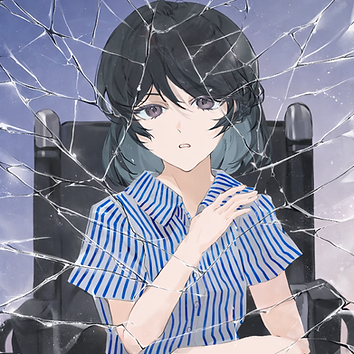
The girl depicted in the painting lives with osteogenesis imperfecta, commonly known as “brittle bone disease.” Individuals with this condition have extremely fragile bones, which limit their ability to walk or run freely, leaving the girl confined to a wheelchair. She wears a blue-and-white striped shirt, her dark hair gently falling, and her eyes carry a quiet sorrow. One hand rests against her chest, revealing a sense of calm endurance beneath persistent pain. The shattered mirror before her mirrors the fragility of her bones—always at risk of breaking, at an unpredictable moment.

Artwork Interpretation | Struggling Steps
Creator: Rare not Alone Organization
Duchenne muscular dystrophy causes progressive muscle weakness over time, eventually leading to muscle degeneration and replacement by fat and connective tissue. In this artwork, the boy walks on his toes, with enlarged calves, bent joints, wasted thighs, a protruding abdomen, underdeveloped gluteal muscles, and an unnatural positioning of his arms and shoulders. These physical manifestations arise from progressive muscle weakness and degeneration, in which functional muscle tissue is gradually replaced by fat and connective tissue.
Artwork Interpretation | Bubbles in the Lungs
Creator: Rare not Alone Organization
The lungs in the painting are anatomically revealed and, through an exaggerated visual approach, portray the infected state of the lungs in patients with pulmonary alveolar proteinosis (PAP). The alveoli are symbolically represented as clusters of grape-like bubbles, accurately reflecting their structural characteristics. These fragile, delicate bubbles resemble a diseased organ calling for help. With each breath, the bubbles seem to cry out repeatedly, their silent pleas echoing within the lung cavities—unheard by the outside world.


Artwork Interpretation | The Disordered Dance
Creator: Rare not Alone Organization
The figure in the painting appears to be dancing, yet this is not a voluntary or controlled movement. Rather, the body moves involuntarily, only resembling a dance on the surface. Uncontrolled bodily movements are a hallmark symptom of Huntington’s disease. This artwork captures a dance that seems graceful at first glance but is, in reality, filled with sorrow—hence the title The Disordered Dance. The background is rendered in blue tones, symbolizing compassion toward illness and an enduring, hopeful outlook.
Artwork Interpretation | Wings Through Thorns
Creator: Rare not Alone Organization
Epidermolysis bullosa is a group of rare inherited skin disorders in which the skin and mucosal tissues—such as the eyes, mouth, and esophagus—develop blisters or blood-filled lesions in response to even minor friction. This artwork depicts an infant in the form of a butterfly-like fairy. Butterflies are beautiful yet fragile; even the lightest touch can damage their wings, mirroring the delicate skin of individuals with epidermolysis bullosa. The red markings on the fairy’s wings and body symbolize the blood-filled blisters associated with the condition. The fairy’s peaceful sleeping posture conveys a hopeful wish that patients may one day live in comfort, free from pain and suffering. The blue background represents calmness and healing, while the surrounding pink border resembles a gentle protective circle, symbolizing society’s care and guardianship for those affected.


Artwork Interpretation | Frozen Within
Creator: Rare not Alone Organization
Through the depiction of a powerless body and the imagery of ice, the artwork conveys the physical immobility experienced by individuals with amyotrophic lateral sclerosis (ALS). While patients with ALS remain cognitively aware, they gradually lose voluntary control over their bodies. This harsh reality is expressed through the figure’s helpless posture and the surrounding ice, as if the body itself has been frozen in place.
Artwork Interpretation | A Smile in the Shadows
Creator: Rare not Alone Organization
This artwork portrays a smiling child living with Angelman syndrome. While Angelman syndrome limits a child’s ability to express the world through spoken language, it often endows them with smiles that are pure and profoundly genuine. Through this single smile, the artist hopes to reveal the vitality that persists behind disease—a life that remains vivid and luminous even while living in the shadows of medicine and society. This is not merely a portrait, but a call: to see them, to understand them, and to treat them with gentleness.

Epilogue
We hope that, after walking through this exhibition, you have gained a deeper understanding of rare diseases. Rare diseases take many forms, and each can profoundly affect patients—both physically and psychologically.
Through these artworks, we have used artistic expression to portray the visible features of rare diseases, with the hope of fostering greater awareness, respect, and empathy for those living with them.
When you engage in medical practice, we hope you will remember the rare disease community.
When you encounter individuals who appear different from others in public spaces, we hope your gaze will be one of understanding and respect.
When you meet someone unlike yourself in the classroom, we hope you will collaborate with them as equals, learning and growing together.
Rare is Rare but never Alone.