

Rare Disease Art Gallery at Children's Hospital
Location: First Floor Lobby of the Outpatient Department, Guangzhou Women and Children's Medical Center (Zhujiangxincheng Campus)
Time: Launched on February 28 (International Rare Disease Day), the exhibition will remain permanently displayed in the hospital


Scenes from theArt Gallery
People's Experience in the Gallery


Now, we invite you to step into the world of rare diseases.
Forward

When a category of disease affects only “a few people” (approximately 3.5%–5.9% of the global population), does it therefore not deserve to be seen?
Around the world, patients with any single rare disease may constitute only a “minority” within the population. Yet when these minorities are considered together, more than 300 million people globally are living with rare diseases.
Rare diseases are not just medical conditions; they are also social challenges. They often lead to prolonged periods of misdiagnosis, limited treatment options, and long-term psychological and financial burdens. In this hospital, through artistic expression and scientific interpretation, this rare disease–themed art gallery aims to foster public understanding of a simple truth: rarity does not mean insignificance, and a small patient population does not justify being unheard.

Artwork Interpretation | Vestige
Creator: Rare not Alone Organization
Tuberous sclerosis complex (TSC) is an autosomal dominant neurocutaneous syndrome that leads to the development of benign tumors in multiple organs. Patients may present with abnormal patches and nodules on the skin. In this artwork, the side profile of a woman with her eyes closed serves as the central figure, while dots and patterned motifs symbolize the cutaneous manifestations of the condition. The background is rendered in warm tones, conveying a sense of optimism and emotional resilience in the face of illness.


Artwork Interpretation | Photophobia
Creator: Rare not Alone Organization
The figure’s silvery-white hair, eyebrows, eyelashes, and skin represent the characteristic features of albinism, corresponding to impaired melanin synthesis caused by tyrosinase deficiency. Through the use of light and shadow, the artwork conveys clinical ophthalmic manifestations such as photophobia and visual impairment. At the same time, it highlights the unique beauty of individuals with albinism and their heightened sensitivity to the gaze of the outside world, calling for greater understanding and inclusivity.
Artwork Interpretation | A Fragile Body
Creator: Rare not Alone Organization
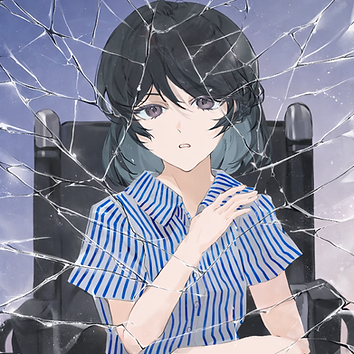
The girl depicted in the painting lives with osteogenesis imperfecta, commonly known as “brittle bone disease.” Individuals with this condition have extremely fragile bones, which limit their ability to walk or run freely, leaving the girl confined to a wheelchair. She wears a blue-and-white striped shirt, her dark hair gently falling, and her eyes carry a quiet sorrow. One hand rests against her chest, revealing a sense of calm endurance beneath persistent pain. The shattered mirror before her mirrors the fragility of her bones—always at risk of breaking, at an unpredictable moment.

Artwork Interpretation | Struggling Steps
Creator: Rare not Alone Organization
Duchenne muscular dystrophy causes progressive muscle weakness over time, eventually leading to muscle degeneration and replacement by fat and connective tissue. In this artwork, the boy walks on his toes, with enlarged calves, bent joints, wasted thighs, a protruding abdomen, underdeveloped gluteal muscles, and an unnatural positioning of his arms and shoulders. These physical manifestations arise from progressive muscle weakness and degeneration, in which functional muscle tissue is gradually replaced by fat and connective tissue.

Artwork Interpretation | The Disordered Dance
Creator: Rare not Alone Organization
The figure in the painting appears to be dancing, yet this is not a voluntary or controlled movement. Rather, the body moves involuntarily, only resembling a dance on the surface. Uncontrolled bodily movements are a hallmark symptom of Huntington’s disease. This artwork captures a dance that seems graceful at first glance but is, in reality, filled with sorrow—hence the title The Disordered Dance. The background is rendered in blue tones, symbolizing compassion toward illness and an enduring, hopeful outlook.
Artwork Interpretation | Wings Through Thorns
Creator: Rare not Alone Organization
Epidermolysis bullosa is a group of rare inherited skin disorders in which the skin and mucosal tissues—such as the eyes, mouth, and esophagus—develop blisters or blood-filled lesions in response to even minor friction. This artwork depicts an infant in the form of a butterfly-like fairy. Butterflies are beautiful yet fragile; even the lightest touch can damage their wings, mirroring the delicate skin of individuals with epidermolysis bullosa. The red markings on the fairy’s wings and body symbolize the blood-filled blisters associated with the condition. The fairy’s peaceful sleeping posture conveys a hopeful wish that patients may one day live in comfort, free from pain and suffering. The blue background represents calmness and healing, while the surrounding pink border resembles a gentle protective circle, symbolizing society’s care and guardianship for those affected.


Artwork Interpretation | Frozen Within
Creator: Rare not Alone Organization
Through the depiction of a powerless body and the imagery of ice, the artwork conveys the physical immobility experienced by individuals with amyotrophic lateral sclerosis (ALS). While patients with ALS remain cognitively aware, they gradually lose voluntary control over their bodies. This harsh reality is expressed through the figure’s helpless posture and the surrounding ice, as if the body itself has been frozen in place.
Artwork Interpretation | A Smile in the Shadows
Creator: Rare not Alone Organization
This artwork portrays a smiling child living with Angelman syndrome. While Angelman syndrome limits a child’s ability to express the world through spoken language, it often endows them with smiles that are pure and profoundly genuine. Through this single smile, the artist hopes to reveal the vitality that persists behind disease—a life that remains vivid and luminous even while living in the shadows of medicine and society. This is not merely a portrait, but a call: to see them, to understand them, and to treat them with gentleness.
